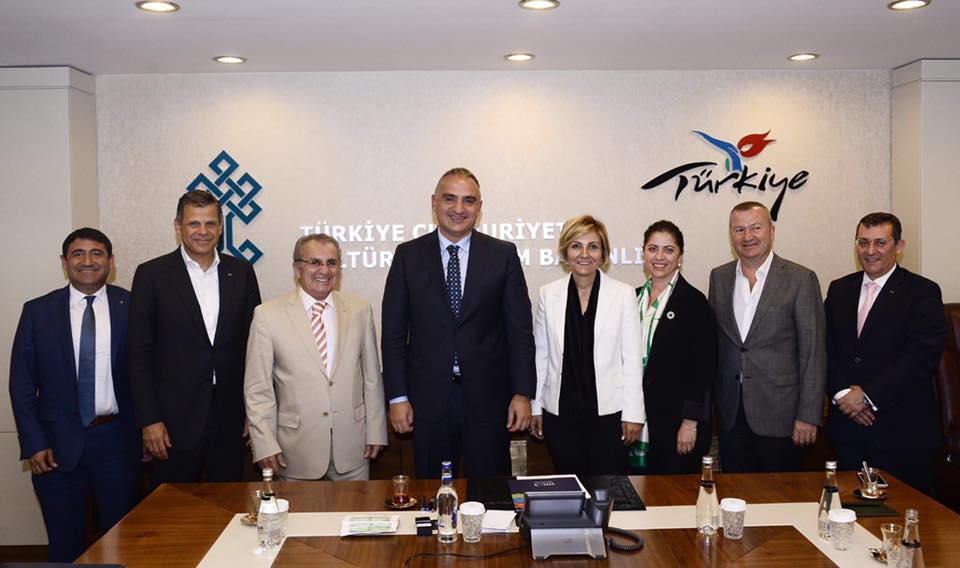
TÜROB delegation visits Minister Mehmet Ersoy...
The President of the Association of Turkish Hoteliers (TÜROB), Timur Bayındır, and the accompanying TÜROB delegation visited Minister of Culture and Tourism Mehmet Ersoy along with Deputy Ministers Nadir Alpaslan and Ömer Arısoy, assessing the sector’s agenda and the work being carried out by the Ministry. The delegation included TÜROB Vice Presidents Armin Zerunyan and Muberra Eresin, Secretary General Hediye Güral Gür, Board Members Taner Yallagöz and Nuri Kalyoncu, General Manager İsmail Taşdemir and Ankara Office Manager Özlem Dağ.
The management of the Association of Turkish Hoteliers (TÜROB) visited Minister of Culture and Tourism Mehmet Ersoy. In his remarks during the visit, TÜROB President Timur Bayındır stated that the most important expectation for the tourism sector was the acceleration of revenue-boosting initiatives, noting that applying a VAT exemption to help our country stand out with its advantages in international congress tenders would be beneficial. Touching also on the excess supply of investment in the accommodation sector, Bayındır drew attention to the need for incentives to be granted for renovation rather than for new investment. Bayındır also pointed out that the process of closing Atatürk Airport would adversely affect the hotels in the area.
The management of the Association of Turkish Hoteliers (TÜROB) paid its first visit to Minister of Culture and Tourism Mehmet Ersoy. In addition to TÜROB President Timur Bayındır, the TÜROB delegation—comprising Vice Presidents Müberra Eresin and Armin Zerunyan, Secretary General Hediye Güral Gür, Board Members Taner Yallagöz and Nuri Kalyoncu, and TÜROB General Manager İsmail Taşdemir—also visited Deputy Ministers Nadir Alpaslan and Ömer Arısoy as part of its Ankara contacts. During its visit to Minister Ersoy, the TÜROB delegation also submitted a report setting out the accommodation sector’s short-term expectations. In his remarks during the visit, TÜROB President Timur Bayındır stated that the most important expectation for the tourism sector at present was the acceleration of revenue-boosting initiatives, saying: “Initiatives in congress tourism, one of the most important tourism segments in terms of revenue and high-quality guests in particular, must be increased.”
Proposal for an Investment Monitoring Board
Stating that applying a VAT exemption to the congress scope on a tender-specific basis would be beneficial in order for our country to stand out with its advantages in international congress tenders, Bayındır said: “For associations, companies or institutions that are invited to come to our country for congress tourism, having congress expenses such as the congress center, accommodation and intermediary services exempt from VAT becomes a deciding factor.” Noting that, for the sake of restructuring tourism, the outcomes and decisions of the 3rd Tourism Council held in November 2017 must be put into practice, he stated that sector organizations should be included in the work the Ministry carries out to promote and market Turkish tourism. Proposing the establishment of an ‘Investment Monitoring Board’ to eliminate the lack of planning in tourism investments and the excess in accommodation, Bayındır stated that the ‘Investment Incentive System’ should also be revised and that incentives should be granted for renovation rather than for new investment. Pointing out that the process of closing Atatürk Airport would adversely affect the hotels in the area, Bayındır emphasized that, together with the new airport, Atatürk Airport could also continue its operations.
The report submitted by TÜROB to Minister Ersoy included, in summary, the following views:
COUNCIL DECISIONS MUST BE IMPLEMENTED
* In order to achieve restructuring in tourism, the outcomes and decisions of the 3rd Tourism Council—held between 1–3 November 2017, which addressed tourism from many different angles through special commissions—must be implemented swiftly. Developments in this regard should be shared with the sector.
A POOL SYSTEM FOR COPYRIGHT
* The ‘Draft Bill on Amending Law No. 5846 on Intellectual and Artistic Works’ prepared by your Ministry should be arranged in line with our sector’s expectations.
The introduction of a single point of contact and single payment system (pool system) covering all rights,
The broadening of the copyright application to a wider base and the introduction of a new certification system that will not victimize users in this regard, opening the way for use at low fees,
In the penalties section, since our sector’s businesses do not derive commercial gain from broadcasts, the removal of prison sentences by making an arrangement in line with ‘applying an economic penalty for an economic offense’,
The acceptance that hotel rooms are not paid-entry public premises for the purposes of viewing radio and TV broadcasts, the removal of any amendment to this effect from the text of the article, and furthermore the non-granting of authority to separate professional organizations for licensing in paid-entry public premises either, with this problem being resolved through a joint licensing union.
CONGRESS TOURISM MUST BE REVITALIZED
Initiatives in congress tourism, one of the most important tourism segments in terms of revenue and high-quality guests in particular, must be increased. For congress tourism guests, one of the most important revenue groups in the tourism sector, applying a VAT exemption to the congress scope on a tender-specific basis would be beneficial in order for our country to stand out with its advantages in international congress tenders. For associations/companies or institutions that are invited to come to our country for congress tourism, having congress expenses (congress center, accommodation, intermediary services) exempt from VAT becomes a deciding factor. The exemption should be provided to the institution/company holding the congress or to the organizer authorized on behalf of the congress holder.
In addition, in terms of developing and diversifying our infrastructure in the congress field, initiatives to realize the M’expo Center, designed by the Istanbul Maltepe Municipality, should be supported.
In order to increase spending per tourist, revenue-boosting tourism products should be supported. For example, through the Kayseri-Cappadocia Roadshow organization held at the end of July in cooperation with our Association, Radisson Blu Kayseri and THY, a culture + winter tourism product was promoted as a package for the Ukrainian market. While the invited tour operators and officials provided very positive feedback regarding the product and the package, they stated that, because transport opportunities are limited and Istanbul connections are insufficient and at fixed times, offering a flight alternative is essential. For revenue-boosting tourism products such as winter tourism, culture tourism and gastronomy tourism, developing and facilitating individual and group flight opportunities for target markets in particular is very important.
LET THE SECTOR BE INCLUDED IN PROMOTION
Sector organizations should be included in the work our Ministry carries out to promote and market Turkish tourism. Obtaining the views and proposals of sector organizations regarding the projects and agency work to be carried out as part of our country’s national and international promotion and marketing activities would be highly beneficial for strengthening sector cooperation and for an inclusive tourism strategy. As was previously the case, the Ministry of Culture and Tourism should ensure cooperation with tourism sector organizations at every stage of tenders, fairs, workshops, assessments and other promotion and marketing activities. Overseas promotion should be redesigned and conducted under the Ministry’s coordination, together with representatives of civil society.
A MONITORING BOARD TO PREVENT UNPLANNED INVESTMENTS
An ‘Investment Monitoring Board’ should be established to ensure that tourism investments are planned in a sustainable manner, and the ‘Investment Incentive System’ should be revised. Article 16 of Tourism Incentive Law No. 2634 should be applied. For the sake of sustainable tourism and competitive conditions, in order to ensure that hotel investments are planned correctly, an ‘Investment Monitoring Board’ to be established jointly by sector organizations, the Ministry of Culture and Tourism and the Ministry of Trade will not only ensure correct planning but will also eliminate inter-regional disparities and bring solutions to the problems of seasonality and regionality in tourism. By revising the investment incentive system, the spread of tourism investments to our Anatolian provinces in proportion to demand should be ensured, and—taking into account that our existing hotels, primarily in our provinces of Antalya, Istanbul, Aydın and Muğla, have entered a period of wear and tear—the incentive certificates to be granted to these provinces should focus on the modernization and renovation of existing investments. The MANDATORY RULE for ‘Electricity, Water and Natural Gas’ to be paid at the lowest unit price, contained in Article 16 of Tourism Incentive Law No. 2634, which is still in force, is not being applied; the application of the relevant article should be reinstated as soon as possible.
LET SIRKECI BE INCLUDED IN THE ZONING AMNESTY
The structures located within the Historic Peninsula, primarily in Sirkeci, should also be included in the Zoning Amnesty (İmar Barışı) application. All structures in rural and urban areas built without a permit or contrary to permit annexes before 31 December 2017 have been brought within the scope of the ‘Zoning Amnesty’. Only the Bosphorus Coastal Strip and forefront zone, the areas around Sultanahmet and Süleymaniye in Istanbul’s Historic Peninsula, and the locations designated in the Gallipoli Historic Area have been kept outside this scope. Provision should be made for other structures—excluding buildings and structures built in areas containing historical artifacts and remains in the district, primarily in Sirkeci—to benefit from the ‘Zoning Amnesty’ announced by our government. Taking into account the cultural and geographical fabric of the district, buildings and structures should be subject to assessment on their own individual merits, and the ‘Zoning Amnesty’ should be arranged so as to also apply to structures in the Historic Peninsula other than those of historical-artifact character and/or those that spoil the silhouette.
THE PROCESS OF CLOSING ATATÜRK AIRPORT
The process of closing Atatürk Airport should be planned in a way that does not adversely affect the sector.
As announced by President Recep Tayyip Erdoğan at the Beştepe National Congress Center in the Presidential Complex as part of the new system’s first 100-day action program, with the passenger services of Istanbul’s 3rd airport becoming operational, Atatürk Airport will be gradually closed as of 29 October 2018 and this area will be transformed into Turkey’s largest National Garden. The impact this process will have on the business volumes of the hotel businesses located in the area, and the assessment of the process from the perspective of our sector, are highly important for the region and for Istanbul tourism.
In other metropolitan cities of the world, more than one airport operates. For example, London has 5, Moscow 6 and Paris 3 airports. Alongside the infrastructure that has developed around Atatürk Airport and the economy it has created, the airport should continue its normal operations, taking into account its strategic location for the survival of our country’s national security.
If Atatürk Airport is to be closed wholly or partially, then—taking into account Istanbul’s lack of a fair & event center—reorganizing the airport terminals and repurposing them as a ‘Fair, Congress and Event Center’ is important for the sustainability of the region’s existing developed infrastructure and economy. In addition, being able to reach an agreement with internationally branded entertainment centers/theme parks such as Disneyland in particular would be a highly significant breakthrough for our country’s tourism.
Number of hotels in the district : 62
Total number of rooms in the district : 13,233
Total number of beds : 27,000
Average occupancy rate of district hotels in 2017 : 62.5 percent
Average occupancy rate of district hotels in 2018 : 80 percent
2017 accommodation revenue : 230.4 million Euros
2018 accommodation revenue (year-end expectation) : 291.2 million Euros
Approximate annual added value provided together with ancillary revenues : 500 million Euros
Employment provided : 50,000 people through the multiplier effect