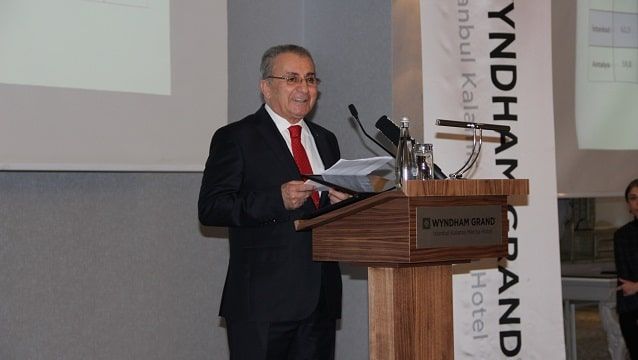
The Traditional TÜROB Luncheon was held, hosted by the Wyndham Grand İstanbul Kalamış Marina...
Strong signs of recovery in İstanbul, encouraging rise in prices
The increases recorded in both occupancy rates and prices in tourism during the first month of the year provided a morale boost. At the tourism sector's 'Traditional Gathering' held at the Wyndham Grand İstanbul Kalamış Marina Hotel, Timur Bayındır, President of the Association of Turkish Hoteliers (TÜROB), announced that Türkiye's hotel occupancy in January 2018 rose by 28.6 percent to reach 60.6 percent. The average daily rate per room sold stood at 60.1 Euros, an increase of 10.4 percent compared to 2017.
Following the rise in occupancy that began in the final quarter of last year in the accommodation sector, an encouraging increase in prices also began in the first month of this year. Timur Bayındır, President of the Association of Turkish Hoteliers (TÜROB), announced the average occupancy rates and prices at Türkiye's hotels in January 2018. Speaking at the tourism sector's 'Traditional Gathering' hosted by the Wyndham Grand İstanbul Kalamış Marina Hotel, President Bayındır said that Türkiye's average hotel occupancy in January 2018 rose by 28.6 percent compared to the same period in 2017, reaching 60.6 percent. According to the statement made by TÜROB President Timur Bayındır at the meeting, which was also attended by İstanbul Deputy Governor İsmail Gültekin and İstanbul Provincial Director of Culture and Tourism Coşkun Yılmaz, occupancy and prices in tourism during the first month of the year were as follows:
According to the 'January 2018 Country Performance Report' prepared for TÜROB by the global data and analytics company STR, this rate had been 47.1 percent in January 2017. Türkiye recorded the highest rate of increase among European countries. In January 2018, the average daily rate per room sold, known as ADR (Average Daily Rate), stood at 60.1 Euros, an increase of 10.4 percent compared to 2017. In January 2017, this figure had been 54.5 Euros. Revenue per available room (RevPAR), calculated over the total number of rooms, rose by 42.1 percent compared to the previous year, reaching 36.5 Euros. In January 2017, this figure had been 25.6 Euros.
İstanbul above the average
In İstanbul, Türkiye's brand city, the rise in both occupancy and prices exceeded the national average. Hotel occupancy in İstanbul in January 2018 rose by 43.5 percent compared to the same period the previous year, reaching 65.2 percent. In January 2017, this rate had been recorded at 45.4 percent. İstanbul was the destination with the highest increase in occupancy rates in Europe in January 2018, with a rise of 43.5 percent. In İstanbul, the average daily rate per room sold stood at 72.5 Euros, an increase of 11.5 percent compared to 2017. In January 2017, this figure had been 65.1 Euros. Revenue per available room (RevPAR), calculated over the total number of rooms, rose by 59.9 percent compared to the previous year, reaching 47.2 Euros. In January 2017, this figure had been 29.5 Euros.
Prices fell in Antalya
While prices rose at the Türkiye average and in İstanbul, room prices in Antalya recorded a decline.
In Antalya, average occupancy, which had been 50 percent in January 2017, rose by 9.3 percent in January 2018 to reach 54.6 percent. The average daily rate per room sold fell from 44.9 Euros in the same period last year to 43.7 Euros. The average room rate declined by 2.6 percent. In January 2017, this figure had been 44.9 Euros. Revenue per available room, calculated over the total number of rooms, rose by 6.4 percent compared to the previous year, reaching 23.9 Euros. This figure had been 22.4 Euros in January 2017.
The clouds have dispersed, but...
In his speech, TÜROB President Bayındır also addressed expectations for the tourism sector in 2018. Noting that positive signals had come from the main tourism markets in particular for 2018, Bayındır said: "The 32.4 million foreign visitors who came to our country in 2017, while gratifying for our sector, do not mean that our problems have begun to be resolved. What matters is not so much how many people come and go, but how much revenue remains. The clouds have dispersed, but the sun is still not warming us. Despite everything, we see that there are encouraging developments in our main markets in 2018."
The first signs are positive
Noting that the signals coming from European markets in particular were gratifying, Bayındır said: "At the Netherlands and Spain fairs we attended at the start of 2018, we received positive signals for the European market. Next week, at the Berlin Fair, we will also see expectations regarding Germany. However, advance bookings for this market also look positive. This year, we expect a partial recovery in our European markets. Iran, which has gained considerable momentum over the past two years, will once again be among our main source markets in 2018. In addition to the European, Middle Eastern and Iranian markets, as TÜROB we will focus this year particularly on Asia, South America and the Balkans. The more countries, the more continents and the more people we can reach with the same diversity of products, the less we will be adversely affected by fluctuations. Türkiye must definitely open up to India, China and other Far Eastern countries."